1. Total Milk Produced
Record the total litres produced during the month.
Then compare this with the previous month.
If milk is reducing, ask:
* Are cows eating enough?
* Has any cow become sick?
* Are cows losing body condition?
* Has the weather or water supply changed?
Milk production is one of the clearest signs of farm performance.
2. Milk Sold and Income Earned
Not all milk produced becomes income.
Some may be consumed at home, fed to calves, rejected, spoiled, or given away.
Record:
* litres sold;
* selling price;
* total milk income.
This helps you know whether better production is actually improving farm earnings.
3. Total Feed Cost
Feed is usually one of the largest dairy farm expenses.
Record what you spend on:
* hay;
* silage;
* concentrates;
* minerals;
* purchased forage;
* transport of feed.
A farmer should not only ask, “How much feed did I buy?”
The better question is, “How much milk did that feed help me produce?”
4. Cost per Litre of Milk
This number helps show whether the farm is becoming more efficient.
Divide the main monthly production costs by the litres of milk produced.
Even a simple estimate can help you compare months and notice when costs are rising faster than milk income.
If the cost of producing one litre is too close to the selling price, profit is at risk.
5. Number of Productive and Non-Productive Cows
Count how many cows are:
* producing milk;
* pregnant;
* dry;
* waiting for service;
* repeatedly failing to conceive;
* sick or under treatment.
Every cow consumes feed and requires care. But not every cow contributes equally to income.
This number helps the farmer identify animals that need attention and make better herd decisions.
The Bottom Line
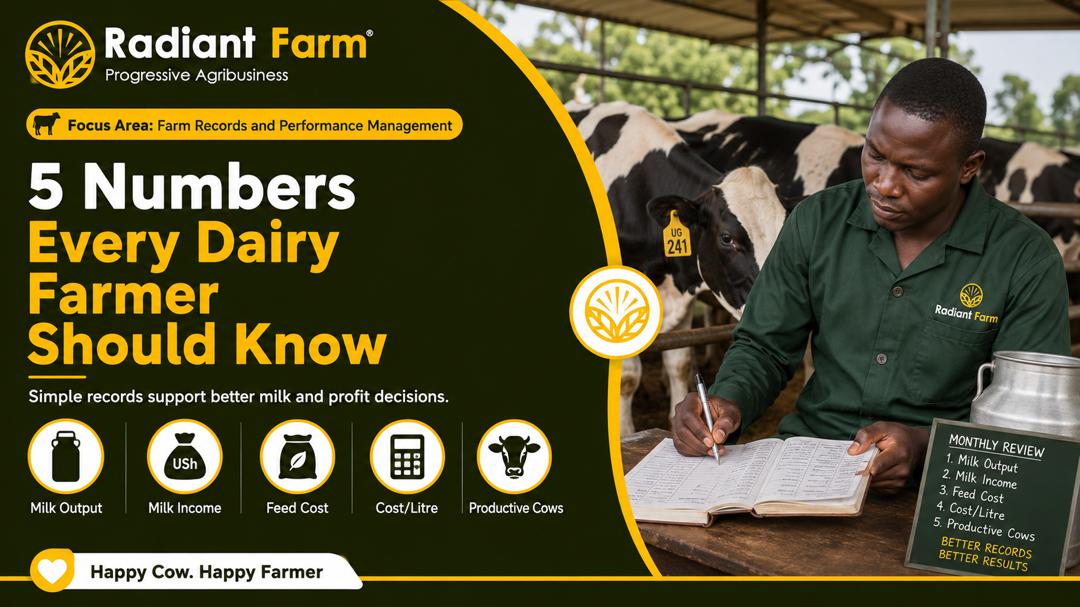
These five numbers tell a simple monthly story:
* How much milk did we produce?
* How much did we sell?
* What did feeding cost?
* What did each litre cost us?
* How many cows are contributing to the business?
A farmer who knows these numbers can act early, reduce losses, and plan with greater confidence.
Good dairy management begins when guessing ends.
Take Action
At the end of this month, sit down with your notebook and calculate these five figures.
Compare them again next month. Over time, the pattern will show what is improving and what needs attention.
Radiant Farm Uganda Limited supports dairy farmers with practical dairy knowledge, quality hay, and maize silage to help build healthier, more productive, and more profitable dairy farms.
📞Contact Radiant Farm today and make every feeding and production decision count.🐄🌽
Order forage from our website (click here) or from the nearby authorised dealer (click here to find out more)
😉 Call / WhatsApp to confirm your Hay or Maize silage ORDER NOW!
📲📞 +256 790 810 337
📲📞 +256 702 350 821
📲 📞+256 702 760 564
📩 Email: kampala@radiantfarmug.com
📍 Farm Location: Plot 5 Kitotolo Road, Nsangabwami Kikandwa, Mityana - Uganda.
By Oliver Namirimu,
The Manager - Production and Operations at Radiant Farm, specializing in sustainable farming practices and animal nutrition.
Please subscribe to our newsletter ( https://radiantfarmug.com/ ) for more updates from Radiant Farm Uganda.