1. Look for what one enterprise can give another
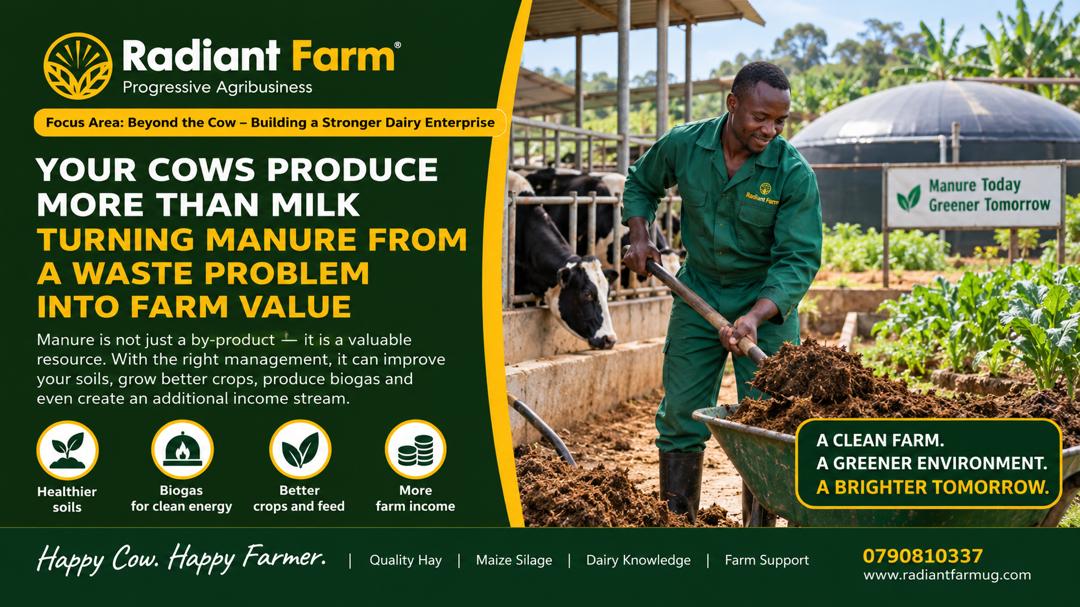
The cow produces milk, but also manure. Crops produce food or cash, but may also leave residues useful elsewhere on the farm. Manure can return nutrients to the soil, while land can produce fodder for livestock.
Instead of asking only, “What does this enterprise earn?”, ask:
“What else on my farm does this enterprise strengthen?”
That question can reveal value that ordinary income calculations miss.
2. Build useful connections
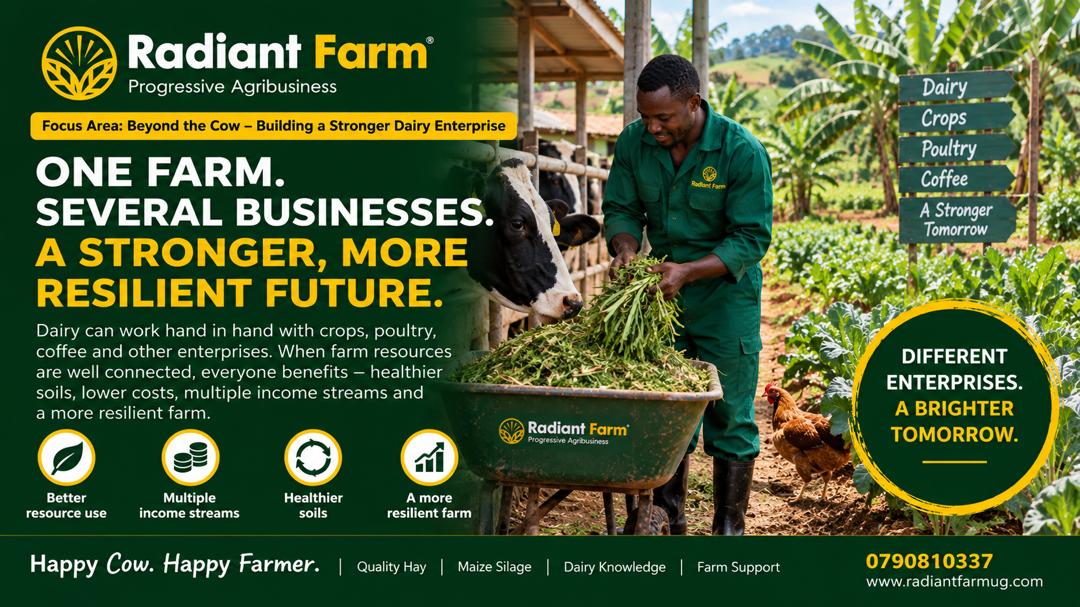
Consider a dairy-and-maize farmer. Maize can provide grain, fodder or material for silage. Dairy manure can support soil fertility for the next crop.
Or consider dairy alongside coffee or bananas. Properly managed organic manure can support crop production, while income does not depend entirely on milk.
The objective is not to add enterprises simply because land is available. Each new activity should have a reason for belonging on the farm.
3. Diversification can spread risk
Milk prices can change. Drought can affect fodder. A crop may have a poor season.
When thoughtfully selected enterprises generate income at different times, one part of the farm may help carry another through a difficult period.
But diversification without management can create the opposite problem: too many activities competing for the farmer’s money, labour and attention.
More enterprises do not automatically mean a stronger farm. Better connections do.
4. Think in circles, not straight lines
Traditional thinking can look like this:
Buy inputs → Produce → Sell → Start again.
A more integrated farm asks whether something can remain useful before leaving the system:
Crops → Cow → Milk + Manure → Soil → Crops → Income → Reinvestment.
That circular thinking can reduce waste and help the farmer get more value from resources already available.
5. Start with the farm you already have
Before introducing another enterprise, walk around your farm and notice what is already there.
What is being wasted?
What are you buying that another farm activity could eventually provide?
Which by-product from one enterprise could become an input somewhere else?
Where could another income stream reduce dependence on milk alone?
You may discover that the next opportunity is not outside your farm. It may already be growing or walking inside it.
The Radiant Thought
A farm becomes stronger not simply because it has many enterprises, but because its enterprises cultivate one another.
What two activities on your farm could work better together?
Radiant Farm Uganda Limited supports farmers with practical dairy knowledge, quality hay and maize silage as they build healthier, more productive and resilient farm enterprises.
Need quality hay, maize silage or practical feeding support for your dairy herd? Contact Radiant Farm today on 0790810337 and let us help you improve productivity and farm returns.
Happy Cow. Happy Farmer.
📞Order forage from our website (click here) or from the nearby authorised dealer (click here to find out more)
😉 Call / WhatsApp to confirm your Hay or Maize silage ORDER NOW!
📩 Email: kampala@radiantfarmug.com
📍 Farm Location: Plot 5 Kitotolo Road, Nsangabwami Kikandwa, Mityana - Uganda.
By Oliver Namirimu,
Team Leader- Enterprise Management at Radiant Farm, specializing in sustainable farming practices and animal nutrition.
Please subscribe to our newsletter ( https://radiantfarmug.com/ ) for more updates from Radiant Farm Uganda.