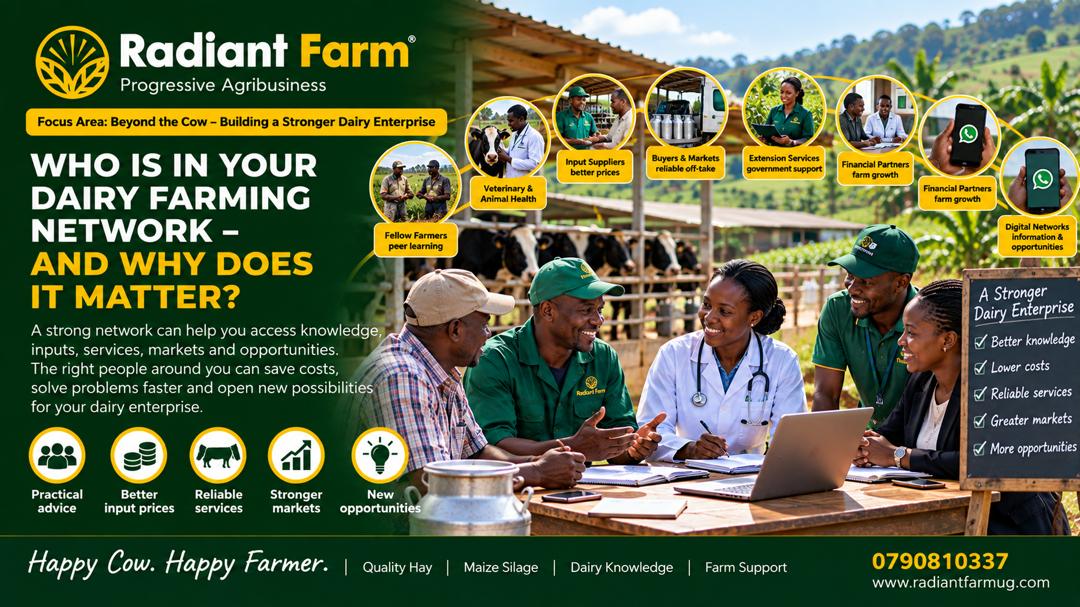
1. Your network can shorten the distance to an answer
A cow becomes sick. A buyer changes terms. You need an artificial insemination technician. A new disease appears. Someone announces a farmer training or financing opportunity.
Where do you turn?
A useful network might include another experienced farmer, veterinarian, extension officer, input supplier, milk buyer, processor, researcher, financier or farmer organisation.
You do not need to know everything yourself.
But it helps to know where reliable knowledge lives.
2. Other farmers can become part of your learning system
Some of the most practical agricultural knowledge is sitting on another farm.
Another farmer may already have tried the equipment you are considering buying, dealt with the pest affecting your pasture, approached the buyer you are considering or made the mistake you are about to make.
Good networks allow farmers to exchange experience, not simply opinions.
The important discipline is to ask:
“What actually happened on your farm, and what did you learn?”
3. Your farming network can now fit inside your phone
Networking no longer requires everyone to meet physically.
WhatsApp groups, online farmer communities, webinars and other digital platforms can connect farmers to information, specialists, markets and opportunities far beyond their immediate neighbourhood.
But speed creates another challenge: bad information can travel just as quickly as good information.
Before acting on advice involving animal health, finance, chemicals or major investment, check the source and seek appropriate professional guidance.
A connected farmer should also be a discerning farmer.
4. Relationships can reveal opportunities
Not every opportunity will arrive as an advertisement.
A fellow farmer may mention a new milk buyer. An extension officer may know about a training programme. A financial institution may introduce an agricultural product. A processor may be looking for suppliers. A research institution may need demonstration farms.
Often, opportunities travel through relationships before they reach noticeboards.
That makes networking part of enterprise development, not merely socialising.
5. Don’t only ask what the network can give you
Strong networks work both ways.
What knowledge can you share? Whom can you introduce? Can another farmer learn from something that worked or failed, on your farm?
A network becomes stronger when its members contribute as well as collect.
The Radiant Thought
A farm has boundaries. Learning does not have to.
The farmer who keeps discovering beyond the farm gate brings new possibilities back through it.
One action this week
Draw a simple circle and write your farm’s name in the middle.
Around it, write the names of people or organisations you can currently turn to for animal health, markets, finance, government or extension support, technology and farmer experience.
Where there is an empty space, you have discovered a relationship worth cultivating.
Who does your farm need to know?
Radiant Farm Uganda Limited supports farmers with practical dairy knowledge, quality hay and maize silage as they build healthier, more productive and resilient dairy enterprises.
Need quality hay, maize silage or practical feeding support for your dairy herd? Contact Radiant Farm today on 0790810337 and let us help you improve productivity and farm returns.
Happy Cow. Happy Farmer.
📞Order forage from our website (click here) or from the nearby authorised dealer (click here to find out more)
😉 Call / WhatsApp to confirm your Hay or Maize silage ORDER NOW!
📩 Email: kampala@radiantfarmug.com
📍 Farm Location: Plot 5 Kitotolo Road, Nsangabwami Kikandwa, Mityana - Uganda.
By Oliver Namirimu,
Team Leader- Enterprise Management at Radiant Farm, specializing in sustainable farming practices and animal nutrition.
Please subscribe to our newsletter ( https://radiantfarmug.com/ ) for more updates from Radiant Farm Ug